I’ve played Spelling Bee, I’ve played Wordle. But nothing is as much fun as the problem-solving involved in unraveling the mysteries of genealogy.
Take the intriguing grave marker of Silence Chase: it’s one of those slate slabs featuring an angel’s head and letters carefully carved in Times New Roman. It stands in Trinity Cemetery in what Find-a-Grave calls “Cornish City” next to the gravestone of her husband Samuel Chase (5).
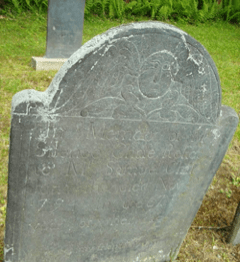
Silence was one of the names that grabbed the grandchildren’s attention as we looked for interesting things in our grandparents’ house in Plainfield, N.H. in the Sixties. If you stood on the red leather couch in the sitting room you could see her name on the family tree, where she was listed as Silence Stone. Even better! My cousin recently reminded me of the fascinating name, so I delved into finding out who she was and where she came from.[1]
From original handwritten records, it quickly became clear that the family tree had the surname wrong, although no one can blame Aunt Carol for seeing Stone. Both handwriting and spelling were variable in the 18th century: here is one example of how Silence’s name was rendered:
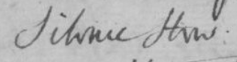
How? Slow? Stone?
Actually, our ancestor’s last name was Stow, at least when that scribe wrote it. Child’s History of Cornish, New Hampshire, says as much. Child even records that our ancestor was born in Grafton, Massachusetts, but what he doesn’t say is that Silence was born with a different last name in another town, which always presents a genealogical challenge.[2]
Silence’s story starts with a death, which is where many stories started in the 1700s in New England. Her father, Thomas Hunt, expired in his hometown of Sudbury, Massachusetts in September of 1727, two months before our Silence was born.[3] The name his widow Martha chose for her “posthumous daughter” is a so-called virtue name, meaning that it celebrates a quality that Puritans prized, like Thankful, Patience and Wealthy. I’d like to think that widow Martha Hunt was mourning the fact that her husband Thomas had died an untimely death, leaving a silence in the family. This is completely unsubstantiated and magical thinking, I’m afraid. (My cursory survey found a few hundred other daughters called Silence in Massachusetts during the 18th century.)
In any case, widow Martha, mother of three girls, put her children into the guardianship of James Jackson of Sudbury in December of 1728, the man she subsequently married in 1730 as her second husband.[4] A few years later Jackson later submitted a record of the expenses he had incurred during the childhoods of Mary, Silence and Ruth Hunt, which is how we know that Silence had measles when she was a girl. Here is what he wrote in 1742 when he petitioned the Middlesex Court for reimbursement from the Hunt estate:
“Item: [Silence’s] support and maintenance from December the 20th 1728 till of the age of seven years, being five years £91
Expenses for medicine and attendance when she had the meazles [sic] and at other times £1- 10s-6pence”
Jackson requested £183 in total for serving as guardian of Martha’s three daughters, all of whom apparently went to other situations when they reached the age of seven. Sadly, the oldest daughter, Martha, died while in his care. James petitioned the estate for a refund of the money he spent on “mourning weeds [clothes] for guardian [i.e., himself]” and 10 pairs of gloves, which were traditionally given out during funeral processions.[5]
In 1741 Jacob Whipple of Grafton became guardian of Silence. She was now 14 years old (and he was an eminently respectable son of a deacon in that town).[6] The change of guardians occurred, you can learn by reading the probate record very carefully, because Martha, Silence’s mother, had died. This is probably when Silence removed to the newly created town of Grafton (incorporated in 1735), formerly known as Hassanamesit. In 1727, the year of Silence’s birth, 40 Englishmen had struck a deal with 7 Nipmuck Indians, the white men paying what seems a reasonable price for once of £2,500 for 7,500 acres.[7] (The tiny band of Nipmucks were so-called “praying Indians,” meaning they had been converted to Christianity, in their case by the proselytizer John Eliot) and therefore were treated with greater largesse than other natives.)
It was in Grafton that Silence became acquainted with Thomas Stow Jr., son of Thomas and Anna Stow, who was a year younger than she was. He was the son of Thomas Stow, Sr., a man with a tract of land in Grafton appraised at £1,656 in 1746 (with a widow and six sons to share the estate, although in this case his oldest son, Thomas, would receive the largest share, £879).[8] Her marriage to the young Thomas in 1748 was a good match for Silence, although sadly it would not survive for long… only long enough for one baby daughter to be born, in late 1749.
(To be continued as Set in Stone, Part Two)
[1] Silence was Mattie Quimby’s great, great, great, great grandmother. Silence’s daughter Sarah E. Chase married Abel Johnson; their daughter Martha married Daniel Cole; their daughter Sarah Cole married Earle Westgate; their son William Westgate married Charlotte Bryant; their daughter Martha (Grammy Great) married Elwin Quimby and so on.
[2] Child, William Henry, History of the town of Cornish New Hampshire, with genealogical records, 1763-1910, Volume II, (1911), p. 60.
[3] There was another Silence Stow born posthumously, to Mary (Wesson) and John Stow of Concord, Massachusetts in 1724. For a while I went on a wild goose chase tracking her down, until I realized that the Silence Stow of Grafton, born in 1727, was a better match. It took me a while to figure out that the maiden name of “our” Silence Stow was Hunt, not Stow and that she had a brief first marriage before marrying Samuel Chase 5. Full disclosure: when I checked Silence Chase’s bio on Find-a-Grave, the author called her Silence Hunt, which did not match William H. Child’s record. That was the hint I needed to eventually find her father Thomas Hunt of Sudbury. One of the difficulties of her case was the fact that the large families of Concord in Massachusetts Bay started migrating in droves once the French and Indian War ended, westward to Sutton and Grafton. The records of Concord/, Sudbury, and Sutton/Grafton are in two different counties, Middlesex and Worcester; the Stows’ land straddled Sutton and Grafton.
[4] MA VR, Sudbury. “Martha [Hunt] married James Jakson 4 Dec 1730.”
[5] Middlesex County Probate Files, Case 12297, available on American Ancestors (NEHGS).
[6]Ibid.
[7] My knowledge of Grafton’s history comes from Frederick Clifton Pierce’s book History of Grafton, Worcester County… (1879).
[8] Worcester County Probate Files, Case 57111, available on American Ancestors (NEHGS).
 LewinWestgateQuimby Family